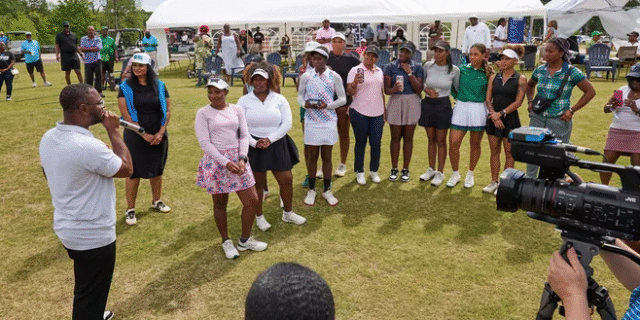

For most people, watching a professional golfer on TV feels simple: a swing, a putt, a leaderboard, a trophy. Behind every woman competing for that moment, there’s a spreadsheet most fans never see — a season’s worth of travel, entry fees, coaching, and lost income that makes up the true cost of women’s professional golf.
For many talented women, especially players of color and HBCU graduates, that math — not their ability — is the main reason their professional dreams stall out.
The dream is real. So is the bill.
At the developmental level, the gap between “good enough to compete” and “able to afford to compete” is wide. A single season can require dozens of flights or long drives, weeks in hotels, practice rounds, caddie fees, and tournament entry costs — all before a player earns a single dollar in prize money.
Unlike established stars with sponsorships and exemptions, emerging women professionals often self-fund those expenses or lean on family and small networks, which makes every tournament a financial risk as much as an athletic opportunity.
What a developmental season actually looks like
On paper, a developmental schedule might look straightforward: six to ten events, spread across several months, in different regions of the country.
In practice, each event carries a stack of hidden and not-so-hidden costs:
- Travel: flights or long drives to each host city, often with little notice as schedules and exemptions change.
- Lodging: multiple nights in hotels or short-term rentals, ideally close to the course so players can rest and prepare.
- Tournament expenses: entry fees, practice round fees, caddie fees, and course access for training.
- Coaching and training: ongoing work with coaches, strength and conditioning support, and specialized equipment.
- Opportunity cost: weeks away from traditional employment or other income-generating work.
It is not unusual for a single fully committed season to cost more than a starting salary in a traditional career path. For a player without major sponsorship or generational wealth, that reality turns every event into a calculation: “Can I afford to chase this opportunity?”
When money becomes the gatekeeper
These costs do more than create stress; they quietly filter out talent. Players with the ability to compete at a high level may never get enough starts to prove it, simply because they can’t shoulder a full schedule.
The impact is especially heavy in communities that have only recently gained access to collegiate golf. HBCU women’s programs are producing more trained, competitive Black women golfers than ever before.
But without a structured, supported professional pathway, that pipeline of talent spills out into a fragmented landscape where too many promising careers end before they really begin.
A different blueprint: investing in the pathway, not just the podium
Changing this story requires more than one-off sponsorships or appearance fees. It takes a reimagined developmental model that treats early-career seasons as a shared investment between players, tours, and partners — not a solo gamble shouldered by the athlete, and not the old, hidden true cost of women’s professional golf.e.
That’s the philosophy behind the Sapphire Golf Tour’s funding framework for its six-city developmental women’s tour: build a structure where every dollar is intentionally aligned with making professional women’s golf more competitive, more accessible, and more sustainable for the players who have already earned their spot.
The framework revolves around five core buckets:
- Prize and purse enhancement
Strengthening purses across all events does more than reward winners. It changes the basic equation of risk and reward for the entire field. When more money is available throughout the leaderboard, players can plan fuller schedules, knowing that solid weeks — not just victories — can help cover costs and fund the next stretch of events. - Player support grants
Need-based grants offset essential expenses like coaching, travel, lodging, and entry fees for players who can’t self-fund an entire development season. These grants recognize that talent is evenly distributed, but resources are not. They make it possible for gifted players from HBCUs and underrepresented communities to compete on the same calendar, in the same fields, as peers with deeper financial backing. - Tour operations and infrastructure
A credible national tour doesn’t just happen. It requires operations staff, event production, marketing, communications, and technology to manage fields, scoring, media, and relationships at every stop. When those costs are covered at the tour level, individual players aren’t forced into the role of their own manager, agent, travel coordinator, and marketing team. They can focus on their craft while the platform around them stays professional and consistent. - Player development programming
Clinics, mentorship, and intentional HBCU pipeline engagement turn tournament weeks into full development experiences. Beyond competition, players gain access to mentorship from former pros, workshops on branding and financial literacy, and structured pathways for emerging collegiate and junior golfers to see — and step into — the next level. - Community and civic activation
Youth outreach, local partnerships, and sponsor activations ensure that each stop on the schedule is anchored in the community, not just dropped into a market. When events connect with local families, businesses, and civic leaders, they generate value beyond the ropes: economic activity, visibility for local partners, and a powerful narrative around women’s sports as a driver of community growth.
What it feels like from a player’s point of view
On a well-structured developmental tour, a player doesn’t simply “show up and hope.” She arrives in a city that has already been prepared for her presence and success.
Purses are strong enough that a top-10 week matters. Travel and lodging are more manageable thanks to support grants or negotiated tour rates. Programming during the week gives her access to mentors, media training, and opportunities to share her story with local youth.
Instead of stringing together a patchwork of mini-tours and one-off events, she moves through a six-city season where every stop is designed to build her résumé, her network, and her confidence.
The biggest difference is psychological as much as financial: she is not alone. The pathway is visible, structured, and built with her in mind.
How partners can align dollars with real impact
For partners who care about equity, community, or long‑term growth in women’s sports, the question is no longer “Should we invest?” It’s “Where will our investment actually change outcomes?”
This five-bucket model gives corporate sponsors, foundations, and civic partners clear choices:
- Those focused on competitive excellence can strengthen purses and performance development.
- Those centered on education, workforce, or economic mobility can invest in player support grants and development programming.
- Those with community and civic missions can anchor community activation and youth outreach in each market.
In every case, the dollars are not scattered. They are tied to specific barriers that have historically kept too many women from taking their best shot at a professional career.
From survival tour to accelerator platform
The world has already decided that women’s sports are worth watching. Viewership, sponsorship, and participation are surging across leagues and sports, and women’s golf is part of that broader wave.
The real question now is whether the systems underneath — the tours, the pathways, the funding models — will evolve fast enough to keep up with the athletes.
When we reimagine developmental golf as an accelerator rather than a survival test, we don’t just change individual careers. We change who the sport belongs to, who sees themselves in it, and which communities benefit from its growth.
For the next generation of women golfers, especially those coming out of HBCUs and historically underrepresented communities, that shift could be the difference between watching from the sidelines and walking up the 18th fairway with a real chance to win.